

Foresight News Exclusive | By Eric, Foresight News
In October 2025, GEOFi network Voyage announced the completion of a $3 million Pre-Seed round, with participating investors including a16z Speedrun, Solana Ventures, AllianceDAO, IOSG Ventures, and others. Individual investors include Trends.fun founder Mable Jiang, Farcaster co-founder Varun Srinivasan, as well as former Uniswap Operations Lead and former IOSG investor Kuan.
GEO's full name is Generative Engine Optimization. The concept emerged after ChatGPT's explosion in early 2023, and was first formally proposed and defined in November 2023 in a paper titled "GEO: Generative Engine Optimization" submitted by a team of scholars from Princeton University and the Indian Institute of Technology. The paper's core thesis states:
"As generative AI search engines rise, traditional SEO (Search Engine Optimization) is gradually becoming ineffective. GEO aims to improve content visibility and citation rates in AI-generated answers through specific content strategies (such as adding authoritative citations, statistics, accessible language, etc.), helping content creators maintain exposure in the 'zero-click' search era."
SEO was one of the most important passive content distribution methods in the PC internet and mobile internet eras. By testing search engine ranking logic, brands could strategically add certain elements to web pages or increase the frequency of certain keywords in articles, so that when users searched for keywords, the brand's links would rank higher.
For example, when someone searches the keyword "Bitcoin," search engines might determine the ranking of each website in search results based on parameters like the website's expertise, keyword frequency, and historical user clicks. In my own Google search, Yahoo Finance, Wikipedia, and TradingView ranked in the top three.

In the search engine era, products and services followed the display-click-transaction funnel model—a very typical traffic-based approach, and traffic was the battleground before the AI era. But after generative AI exploded, users no longer need to manually search for desired results among numerous options—AI directly presents the final answer. This has made AI possibly the only traffic entrance in the future.
AI has brought entirely new distribution logic: previously, websites and apps themselves were traffic entrances, but now the only entrance is AI's dialogue box. For brands, not only can they not completely abandon SEO, they also need to explore how to get their brand cited by AI as much as possible in an era where users no longer find answers through clicking links.
When GEO Meets Web3
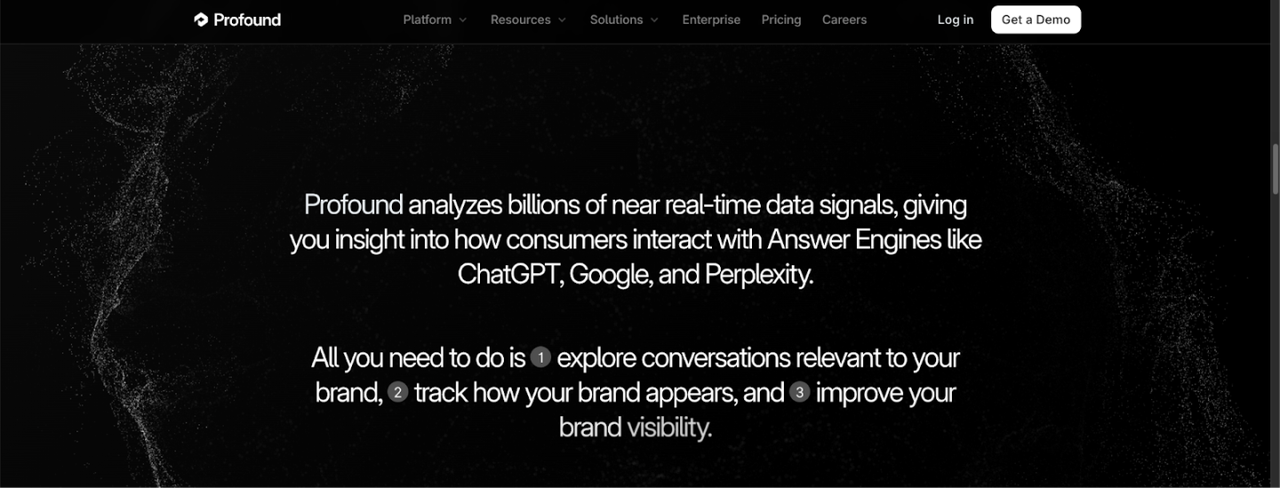
The undisputed leader in GEO is Profound, founded in the United States. This GEO platform, which officially launched its product in 2024, has received investment from top VCs including Sequoia Capital. Founder James Cadwallader previously founded Kyra, a data-driven influencer marketing agency. Profound's clients include Bank of America, DocuSign, Indeed, and others.
Beyond GEO services themselves, Profound's real value lies in its platform-based products, including showing how AI evaluates client brands, how it cites client websites, how AI users ask questions, and positioning client brand rankings within their industry. This sounds somewhat like a consulting company that needs to understand all aspects of client market information through a series of analytical tools before providing customized services.
GEO places higher technical requirements on content design. The common knowledge we need to understand is that AI doesn't actually truly understand semantics—AI's answers are just the most matching text found after countless training iterations, and the inability to judge right from wrong is a major cause of hallucinations. Therefore, for GEO service providers, they need to understand the models behind each AI and the algorithmic logic of AI-generated responses, as well as understand natural language processing and structured data to know the corresponding content design approaches.
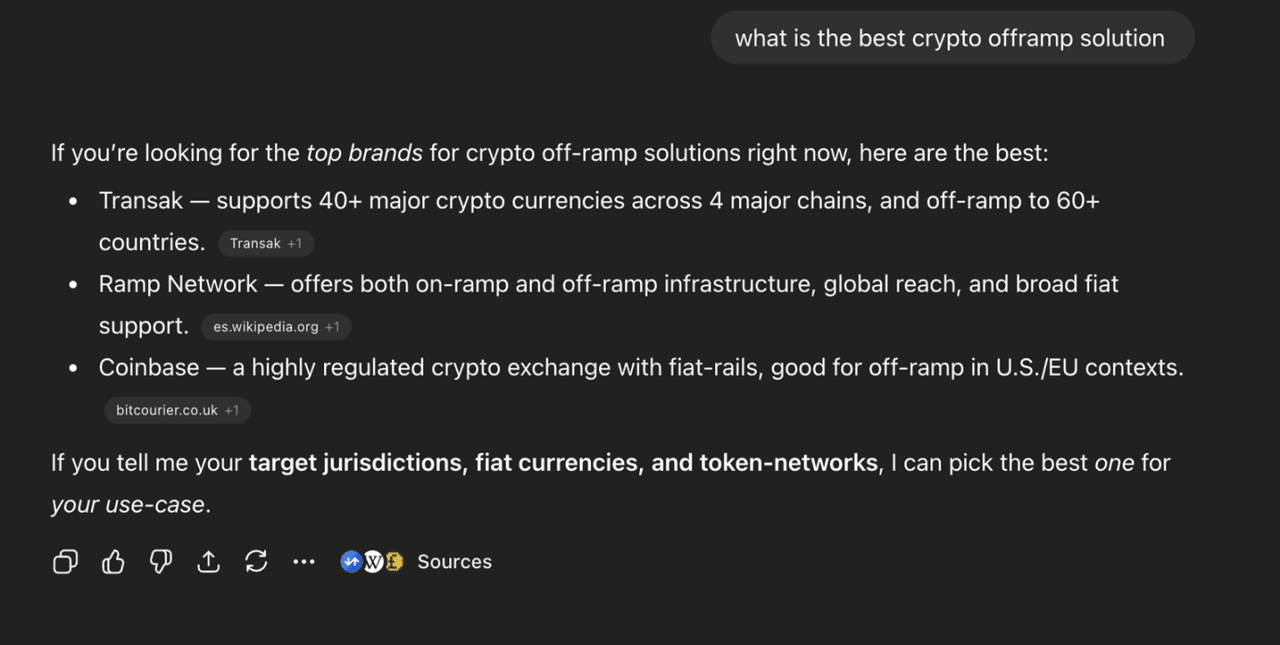
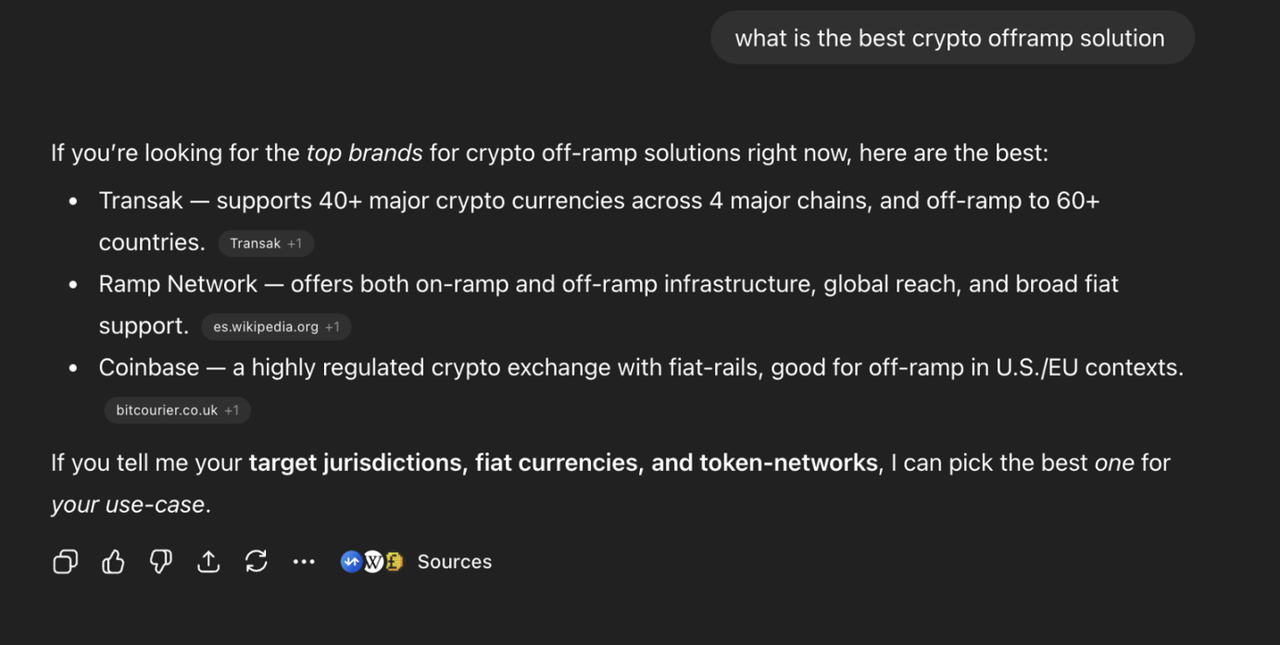
As the GEO proposers stated, citing authoritative literature, providing exclusive data, and simplifying expression may be more easily adopted by AI. When we asked Grok using the Bitcoin keyword, Grok cited websites including the previously mentioned Yahoo and TradingView, as well as media outlet CoinDesk and exchanges Coinbase and Binance.

Therefore, for Web3 projects wanting more exposure in AI responses, the basics would be seeking coverage from media like Yahoo Finance and CoinDesk, and listing on top exchanges including Coinbase and Binance whenever possible. Of course, this is purely from a GEO perspective.
Voyage was also founded under Profound's influence. Co-founder Wallace explained that Voyage was initially not a Web3 company, but a pure GEO service provider. The company would conduct a series of designed queries to AI to determine client companies' rankings within their specific industry in AI, then strategically create relevant content to improve rankings.
Voyage already had numerous clients before pivoting to Web3. One of them initially did NFT-related business before pivoting to payments. Voyage strategically published quality content so that when users queried AI for project information, they could learn about the pivot, while also increasing the project's weight when AI users searched for "Web3 payments" related information.
The fact is, to this day Voyage continues to serve many B2B clients. So why would a company in a hot industry with ongoing business choose to combine with Web3?
Wallace explained that while providing GEO services to clients, they were also thinking: besides letting users know their ranking in a specific AI model and taking targeted actions to improve it, is there a systematic, process-oriented approach that could stably elevate a client's brand "status in AI's mind"?
The conclusion reached: to improve rankings, you must improve the evaluation of the target brand within sources that AI trusts. For GPT, this might mean targeting Reddit, YouTube, etc., while for domestic models, it might mean focusing on Bilibili, Zhihu, Tieba, Xiaohongshu, and similar platforms.
But competing on ad spend on these major platforms is costly on one hand, and there are already mature MCN services on the other—these aren't channels that GEO service providers can control. For startups, the only remaining path is: build a platform that AI can trust yourself. Wallace stated that launching a Reddit-like platform through traditional means is obviously unrealistic, and choosing to combine with Web3 using crypto incentive mechanisms is the most reasonable path.
The core differentiating logic for such a platform is directing the fees AI pays for citations directly to creators. Using Reddit as a cautionary tale—OpenAI pays them tens of millions of dollars annually just for permission to crawl platform data. But for users who diligently answer various professional questions on Reddit, this behavior is more like Reddit leveraging its monopoly position to exchange their knowledge for revenue, just like how many apps today sell users' behavioral data to advertisers.
Although we've said a lot, if you searched for information right after Voyage announced its funding, you would have found the website documentation very simple—so simple it didn't fully explain what Voyage actually wanted to do. Wallace explained, "The long-term goal of establishing a professional, objective, and neutral content platform won't change, but in the early stages we indeed hadn't fully determined how to gradually achieve this goal."
A Brand's "AI Ad Placement Dashboard"
Building such a platform is a plan that sounds wonderful but is extremely difficult in practice. Perhaps the hesitation point was that Voyage considered directly developing the content platform, but ultimately decided to start with GEOFi first.
Voyage's GEOFi stack can be compared to an "AI Ad Placement Dashboard": it contains three components—first, a data analytics tool showing clients' brand rankings in AI; second, a matching platform for brands and content creators; third, a payment protocol allowing brands to pay AI to crawl specific content.
According to documentation, the analytics tool Voyage Analytics integrates historical tracking, user persona-based simulations, and KOL analysis, capable of identifying which communities and contributors have the greatest influence on AI answers, and which optimization efforts yield the highest returns. The result is a real-time AI visualization dashboard helping every organization understand its positioning in the AI space with data-driven insights. It's not hard to see that Voyage's GEOFi will start from projects and users within the Web3 industry.
After a company understands its ranking in AI's eyes, the next step is to improve that ranking. Voyage will develop a platform allowing content creators to connect their Reddit and YouTube accounts while creating a cryptocurrency wallet. This way, brands can invite these creators to produce brand-related content on AI-recognized platforms and pay after confirming it will be indexed by AI algorithms.
Even without brand invitations, creators can independently review products and provide honest evaluations—as long as it's indexed by AI, they can profit. This is a new advertising model in the AI era, and a way for content creators to receive the compensation they deserve when cited by AI. As for the mentioned payments, Voyage extended x402 with attribution, multi-chain support, and geolocation recognition features, launching the v402 protocol.
v402 supports automatic payments when created content is cited by AI, while brands can transparently incentivize content mentioned in AI responses, and can even enhance influence in specific regions through optimized geolocation recognition. Developers can also use the v402 protocol's standardized framework to develop advertising and data gateways for agents.
If you truly understood Voyage's ultimate goal and short-term plans, you should have a similar question to mine: these two seem to have nothing to do with each other. I had this question when I first spoke with the team—compared to GEO, what Voyage ultimately wants to do is more like some kind of "data labeling."
Wallace explained that the reason the goals appear so disconnected is because they believe GEO is actually a "transitional" existence, just like SEO. In a specific historical period, it's an important service, but it might not last forever. In the future, AI won't be hijacked by advertising like search engines, nor should it be guided by SEO-like tactics. Instead, it will demonstrate value through more accurate answers. During the stage when AI is still developing, improving rankings through quality content is a good approach, but it will eventually be replaced by more objective evaluations.
Although GEOFi platform can be called a transition, it's itself a very complex business.
Voyage has many problems to solve, including dealing with frequent updates to various AI algorithm rules that make optimization strategies difficult to stabilize, and content optimization effects that are hard to quantify. For the platform, they need to solve the evaluability of service quality and effectiveness on the server side. Additionally, the professionalism of GEO services makes the head aggregation effect obvious—whether there are really enough enterprises willing to choose the platform to complete this professional service involving multiple platforms and content formats, or even whether there are enough professionally capable contributors, remains unverified.
Web3's Further Penetration into AI
Since the GEOFi product hasn't launched yet, Voyage hasn't welcomed their Web3 project clients. But Wallace said that on the AI side, they're already exploring collaboration possibilities with AI projects like Surf, which just announced funding recently. As I said before, a GEO platform combined with Web3 will also choose to try in the Web3 space first.
In the future, if Web3 projects want to be mentioned more by Surf when users search related tracks, they can use Voyage to understand their project's "position" in Surf and "post bounties" for professionals who can optimize it, paying fees for each Surf citation through the v402 protocol.
When we look back at Voyage's design, what actually involves crypto is just the v402-based payment protocol and the cryptocurrency wallets created to receive payments. But currently, AI's "micro-payments" seem achievable only through the combination of x402 and stablecoins.
So if we now revisit the question "why combine with Web3," we can even say that in some sense, Voyage's GEOFi is "a project that can only be completed with Web3." As for project tokens, Wallace stated that how to further advance the project's development through tokens requires careful thought and exploration as the business progresses—Voyage won't rush to issue tokens.
Given Voyage's various visible difficulties, not over-leveraging expectations is a good choice. For us, we need more time to verify whether VCs including a16z have "misjudged" this time.
After years of countless seemingly reasonable pseudo-demands, Web3 has found a new home in AI. Whether it's GEO, data labeling, computing power, or models, Web3 has played a role in various AI tracks. More importantly, compared to models that need to issue tokens to survive, the continuous real demand in the AI race provides these decentralized projects with sustainable revenue sources, liberating more possibilities for token utility.
[Disclaimer] Markets carry risk; invest with caution. This article does not constitute investment advice. Users should consider whether any opinions, views, or conclusions in this article are appropriate for their specific circumstances. Invest accordingly at your own risk.
Originally published by Foresight News